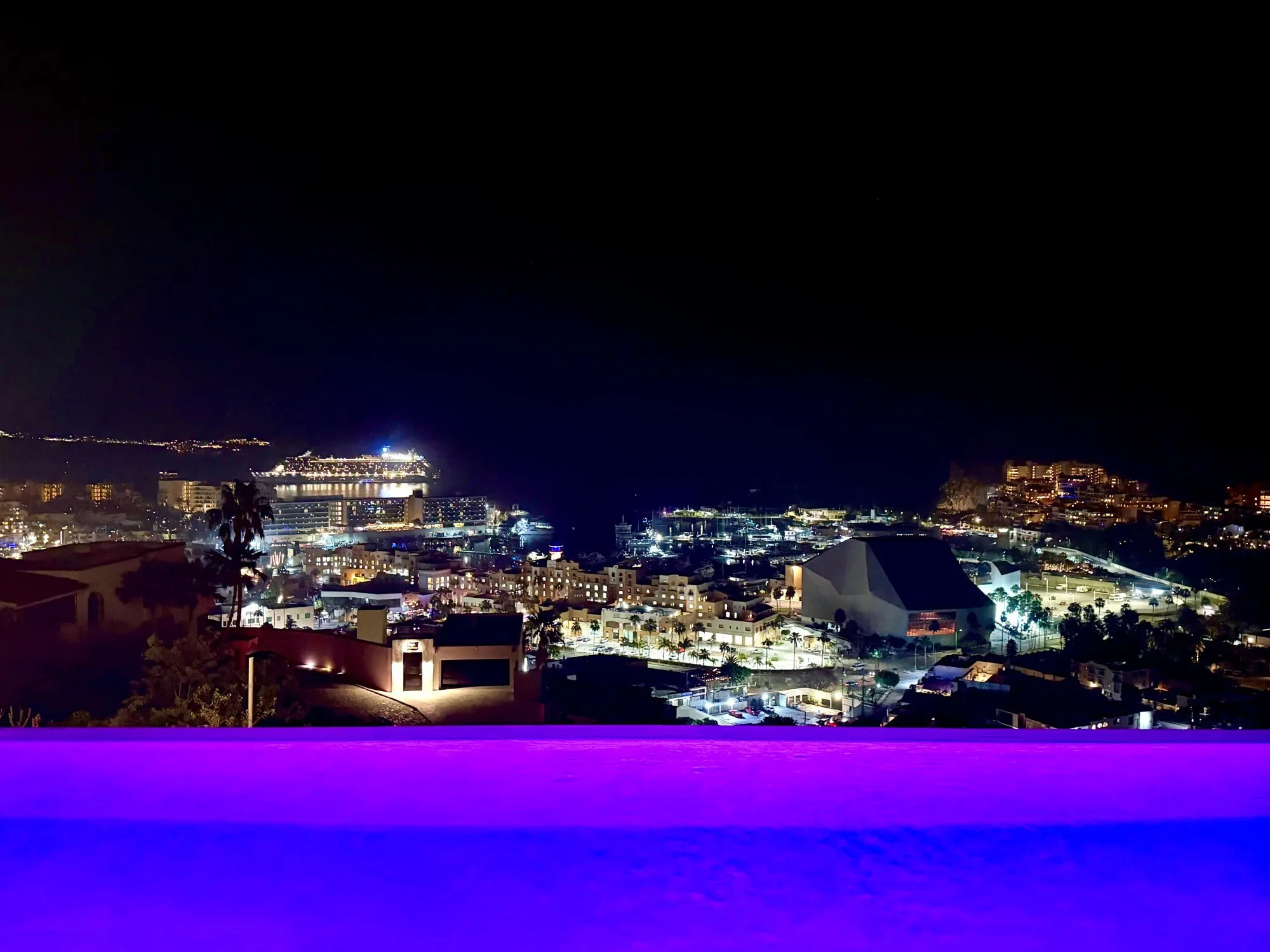
That is the view at about nine at night, looking down over the marina from the hill behind town. The lit object on the left, sitting out on the water away from everything else, is a cruise ship. It is not docked. It cannot be.
Cabo San Lucas has no cruise pier. The marina takes vessels up to about 375 feet. The average ship calling here this year carries 3,785 passengers and is roughly three times that length. So every ship that comes stops outside, drops anchor, and ferries its passengers ashore in small boats — tenders — for as long as the sea allows.
Almost everything strange or frustrating or interesting about a cruise day in Cabo comes out of that single fact, and almost no one explains it before you are standing in a queue.
What tendering actually costs you
A port call sounds like a day. It is not a day.
The ship anchors, clears, and then starts moving people ashore a few hundred at a time. The ride itself is short — roughly ten minutes across the bay to the marina. The queue is the part that eats the morning: fifteen to thirty minutes if you are early and lucky, closer to an hour in the first rush. Then the same thing in reverse at the end, except the reverse queue has a hard deadline attached to it and everybody knows it.
What is left in the middle is, on average, about six hours ashore.
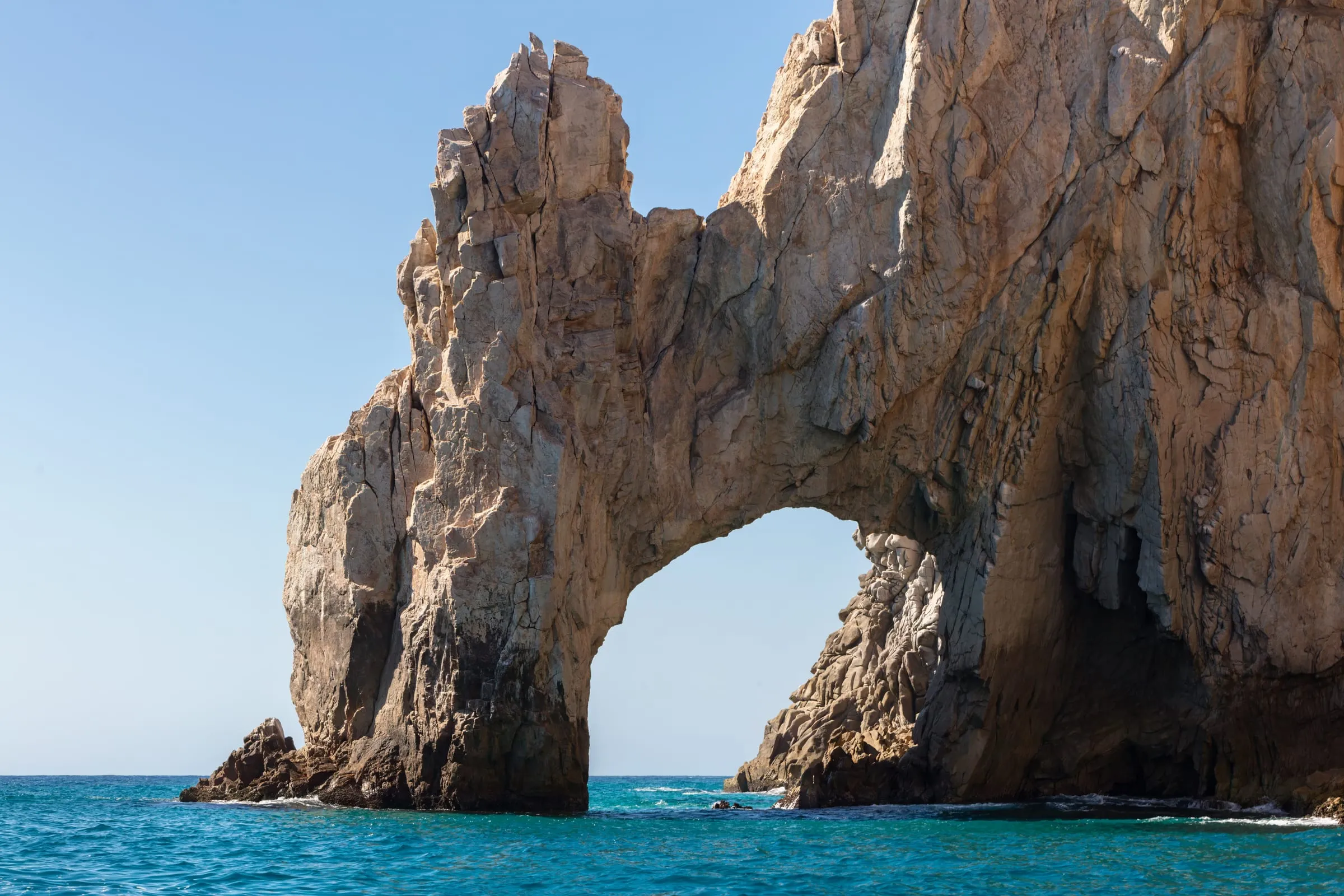
Six hours is enough to do one real thing well. It is not enough to do three. The single most common mistake we see is a family trying to fit the Arch, lunch, a beach and shopping into an afternoon that was always going to be a sprint, and going back aboard having properly enjoyed none of it.
The second thing tendering costs is certainty. Tenders are small boats, and when the swell is up they stop being safe. Tender ports lose calls to weather that a dock would have shrugged off. If a Cabo stop is the reason you booked the itinerary, understand that it is the most cancellable stop on it.
The part nobody mentions: there are a lot more ships now
This is not the Cabo of a few years ago, and the numbers are not subtle.
| Year | Ship arrivals | Passengers |
|---|---|---|
| 2024 | 221 | 778,537 |
| 2025 | 285 | 1,057,758 |
| 2026 (to June) | — | 789,919 |
The 2025 figure was an all-time record. Then the first half of 2026 ran 64.5 per cent ahead of the same months the year before, and projections for the season starting in late September put the port near 700,000 passengers over the winter alone.
Up to four ships can be anchored out there at once. Four ships at this year’s average is roughly fifteen thousand people arriving in a town of about ninety thousand, inside the same three-hour window, nearly all of them walking off the same tender pier into the same half-kilometre of marina.
If you are on the ship
Decide the one thing before you arrive. Book it, and book it for a time that assumes you clear the tender late rather than early.
Take an early tender or a late one, not the middle. The crush is the first hour.
Walk out of the marina. The first two hundred metres off the tender pier are priced and stocked for people with four hours and no information. Ten minutes on foot in any direction and you are in a different town with different prices.
Watch the last tender time, not the all-aboard time. They are not the same number, and the gap between them is the queue.
If the sea looks big, make a flexible plan. A cancelled call with a prepaid excursion is a bad morning.
If you live here, or you are staying on land
This is the half of the story that never gets written, and it is worth more than the other half.
A cruise day is predictable and public. The schedules are published, and they decide which mornings the marina, the Arch boats, the glass-bottom panga operators and the downtown restaurants are at capacity. It is not a mystery and you do not have to guess.
Between about ten and four, on a day with ships in, go somewhere else. That is when the marina loop, the water taxis and the Arch are saturated. It is also, conveniently, exactly when San José del Cabo is pleasant and nearly empty of day-trippers — the old centre is an hour up the corridor and does not take tender traffic.
Before ten and after five belong to you. The bay empties out fast once the last tender runs, and the marina in the evening is a different place entirely.
If you are booking a boat, ask what else is on the water that day. A good operator will tell you straight. A sunset trip on a four-ship day is fine; the same trip at eleven in the morning is not the same trip.
And if you sell anything to visitors, the schedule is a free demand forecast that most businesses here still do not look at.
The thing the photograph gets right
Look at where the ship is sitting. Out beyond the breakwater, past the marina, past the hotels, alone on black water with every light on.
That is the whole relationship in one frame. Fifteen thousand people can be a kilometre from your dinner table and never touch your evening, because the sea between them and the shore is only crossable in small boats and only until the afternoon. Cabo gets the visitors and keeps its nights.
It is a strange arrangement, and the town has quietly built itself around it.
Arrival and passenger figures from DataTur, reported through mid-2026. Photograph taken above Cabo San Lucas marina.